The Aim
The primary aim of Sentinel OS is to bridge the gap between high-level security and human safety by integrating Two-Factor Authentication (2FA) with an automated emergency fail-safe. It seeks to eliminate the "death trap" risk of traditional electronic locks by utilizing thermal sensors to detect fire hazards and trigger an immediate, life-saving override of the locking mechanism.
Detailed Summary
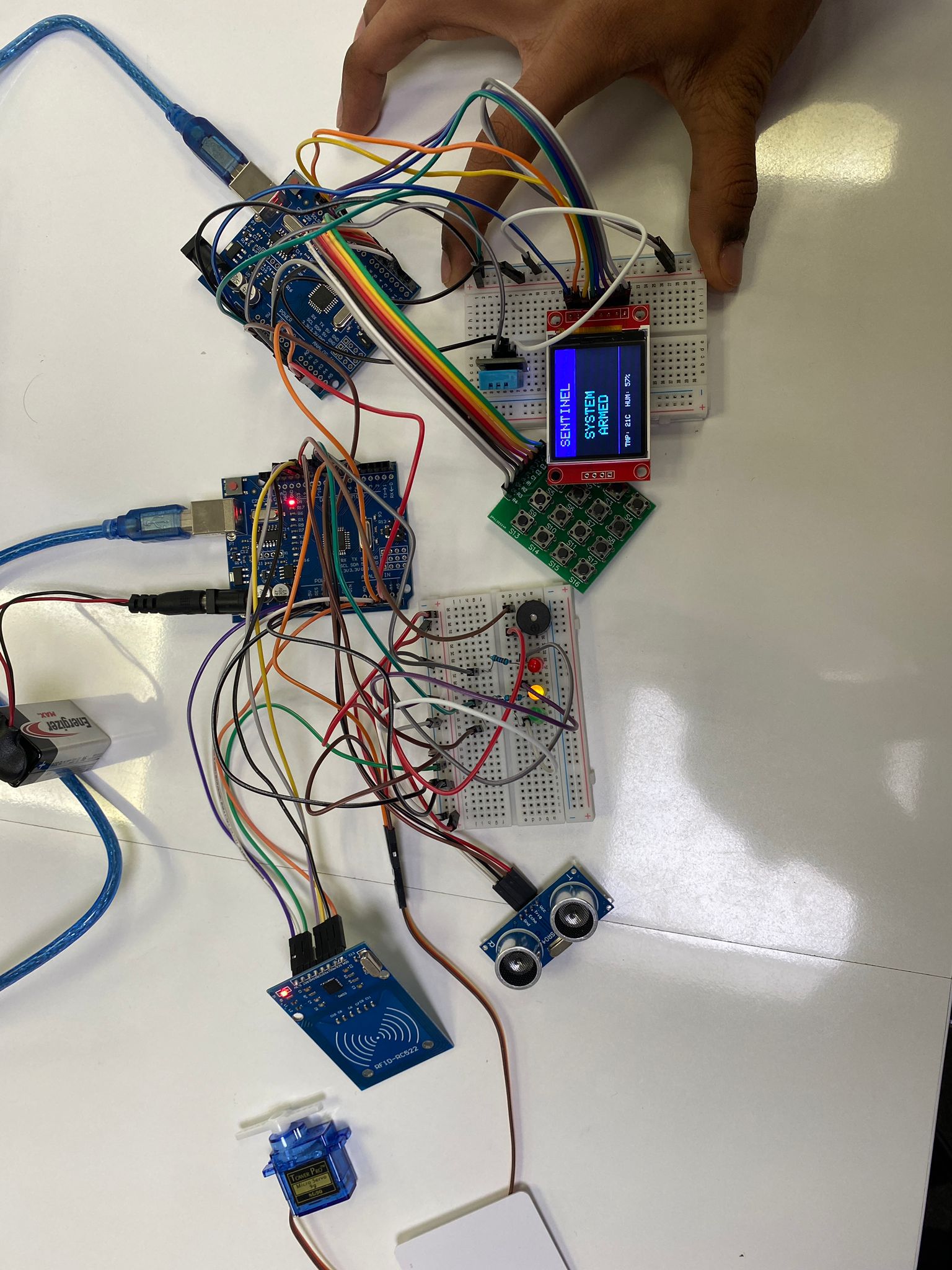
Sentinel OS is a high-security, distributed embedded system designed to provide robust access control while prioritizing human safety during environmental emergencies. Built on a dual-node architecture, the system utilizes two Arduino Uno microcontrollers connected via an I2C communication bridge to separate user interface processing from real-time security monitoring.
This project earned a First Place Win in the Beginner Category.
Key Features & Functionality
Proximity-Activated Wake-up: An ultrasonic sensor detects approaching users within 50cm, transitioning the system from an idle "Armed" state to an active authentication mode.
Two-Factor Authentication (2FA): Access requires both a physical hardware token (RC522 RFID card/fob) and a secure 4-digit knowledge-based PIN entered via a 4x4 matrix keypad.
Persistent Data Memory: User PINs are stored in the microcontroller’s EEPROM, ensuring the security credentials remain saved even after a total power loss or system reset.
Interactive Dashboard: A 1.8-inch TFT LCD provides a real-time graphical interface, displaying system status, live temperature/humidity telemetry, and guided prompts for PIN entry and administrative resets.
Automated Fire Fail-Safe: Integrated with a DHT11 sensor, the system monitors for critical heat levels (≥34°C). Upon detection, it triggers an emergency override that instantly unlocks the door via the servo motor, flashes a red alert, and sounds a high-decibel siren to prevent entrapment.
Administrative Control: Authorized users can utilize a dedicated admin mode to verify current credentials and update the master PIN directly through the device interface.